How does pancreatic cancer affect digestion and nutrition?

The pancreas produces enzymes which digest (break down) food. Pancreatic cancer can affect this process. This means you don’t get all the nutrients you need from your food.

The pancreas produces enzymes that help to break down food. This is part of digestion. Nutrients from the food can then be absorbed into the blood and used by the body. Different pancreatic enzymes help to break down foods containing fat, protein and carbohydrate.
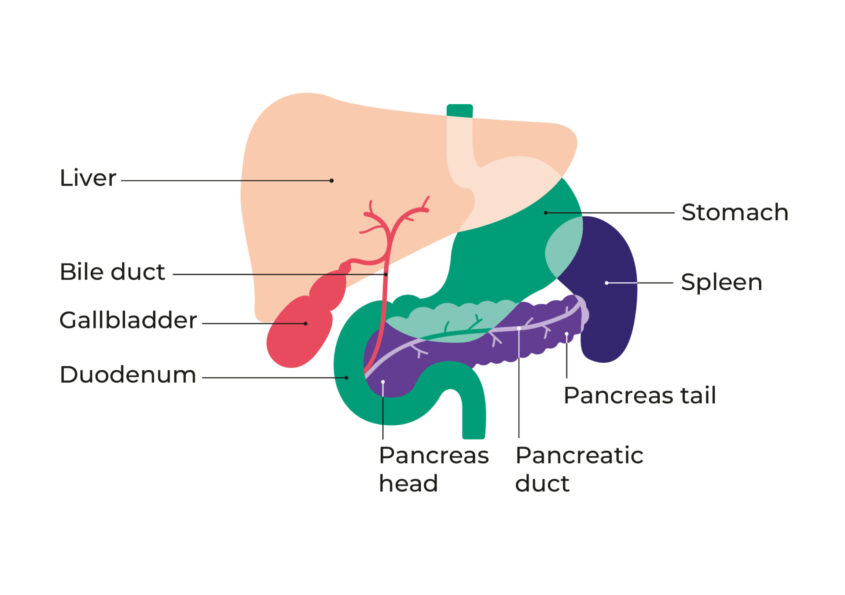
How does pancreatic cancer affect digestion?

  • Pancreatic cancer, or surgery to remove the cancer, can reduce the number of enzymes that your pancreas makes.
  • It can also block the enzymes from getting to the duodenum (first part of the small intestine) where they are needed for digestion. For example, the cancer can block the pancreatic duct, which carries the enzymes from the pancreas to the duodenum.
  • This is called pancreatic exocrine insufficiency (PEI).
  • It means that food is not properly digested, and the nutrients are not absorbed. This is called malabsorption. It can cause symptoms like weight loss.
  • It can be managed with pancreatic enzyme replacement therapy (PERT).

The pancreas and surrounding organs

The organs within the tummy are shown together. The liver and gallbladder are on the left, in front of the stomach. The pancreas sits just behind the bottom of the stomach, pointing out to the right, with the tip of its tail behind the spleen and the duodenum curving in a C shape around the pancreas head. The bile duct (from the gallbladder) and the pancreatic duct both empty into the duodenum.

Our nurses can help

Call, email or WhatsApp our specialist nurses with your questions about digestion and nutrition.

Get support now

References


We have listed some of the references to the sources used to write this information. If you would like the full list of references, email us at  publications@pancreaticcancer.org.uk

  • Nofal YH, Abu Dail Y, Assaf Y, Abo Samra H, Abbas F, Hamzeh A, Alhaj Hasan N. Pancreatic enzyme replacement therapy for steatorrhoea in pancreatic cancer. Cochrane Database of Systematic Reviews. [Online] 2018;2: CD012952. Available from: doi: 10.1002/14651858.CD012952.
  • Layer P, Kashirskaya N and Gubergrits N. Contribution of pancreatic enzyme replacement therapy to survival and quality of life in patients with pancreatic exocrine insufficiency. World Journal of Gastroenterology. 2019; 25(20): 2430-2441. Available from: doi: 10.3748/wjg.v25.i20.2430.
  • Chaudhary A, Domínguez-Muñoz JE, Layer P, Lerch MM. Pancreatic Exocrine Insufficiency as a Complication of Gastrointestinal Surgery and the Impact of Pancreatic Enzyme Replacement Therapy. Digestive Diseases. [Online] 2020;38(1):53-68. Available from: doi: 10.1159/000501675.
  • Tseng DS, Molenaar IQ, Besselink MG, van Eijck CH, Borel Rinkes IH, van Santvoort HC. Pancreatic Exocrine Insufficiency in Patients With Pancreatic or Periampullary Cancer: A Systematic Review. Pancreas. [Online] 2016;45(3):325-330. Available from: doi:10.1097/MPA.0000000000000473.


Updated May 2026

Review date March 2028