
The Rare Cancers Act 2026 – the Bill has officially become law
We are absolutely delighted that on Thursday 5th March, the Rare Cancers Bill passed its final stage in Parliament, receiving Royal Assent and becoming the Rare Cancers Act 2026.
This groundbreaking Act marks a historic step forward for people with pancreatic cancer and other rare cancers.
For decades, pancreatic cancer and other deadly cancers have been overlooked, underfunded and left behind. But this Act has the potential to end this injustice by transforming research into rare and less survivable cancers.
This is the result of thousands of you taking action when we needed you the most. At every stage of the Bill, you have stood with us.
When the Bill was at risk in the House of Commons, you stepped up: in just 24 hours, you sent over 200,000 emails to your MPs and asked them to attend the debate and support the Bill, saving it from failure.
You helped us gain the backing of so many political parties that when the Bill went to the House of Lords, they had no choice but to support it, and it succeeded. Together, we made the impossible possible and achieved something that has never been done before. We passed the first ever legislation specifically targeting pancreatic cancer!
What is the Rare Cancers Act?
The Rare Cancers Act began its journey in Parliament as a Private Members’ Bill introduced by Dr Scott Arthur, MP for Edinburgh South West.
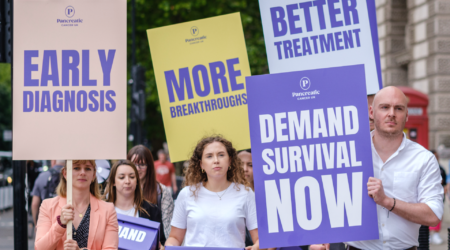
It requires the Government to accelerate research into rare cancers and fund more cutting-edge science to support faster diagnosis and more treatment breakthroughs.
How will the Rare Cancers Act achieve this?
The Rare Cancers Act places three main duties on the UK Government. These are:
- To ensure there is a named lead in Government with a responsibility to support research and innovation for rare cancers
- To ensure patients can get better access to and find out about relevant research and clinical trials
- To review and strengthen orphan drug regulations
How will the Act help people affected by pancreatic cancer?
The Act marks a historic change for pancreatic cancer.
Currently, half of people diagnosed with pancreatic cancer die within three months, yet this disease has historically received only 3% of UK cancer research funding.
The Act will help to transform survival by promoting a greater focus on, and driving greater investment into, this deadly cancer.
New, more effective treatments for rarer cancers are desperately needed. The Act requires this, and future Governments, to accelerate research into these. There is now a duty on them to fund more cutting-edge science, ensure more patients can access clinical trials, and to encourage greater investment from pharmaceutical companies.
What are the next steps for the Act?
Now that the Rare Cancers Act has passed, this is when the work really begins. As the Government focuses on delivery, we must keep the pressure up to ensure the Act leads to better outcomes for people with pancreatic cancer.
The Act will come into force two months after it is passed: 5th April 2026.
The timelines for the Act’s contents are:
- The review of orphan drugs regulations has to be completed within three years of the Act being passed (so no later than 5th March 2029)
- The Government has said it will appoint its rarer cancers lead ‘promptly’
- The England National Cancer Plan states a national clinical lead will be in place in 2026
The National Cancer Plan also says that rarer cancers will become a research priority for the Department of Health and Social Care and the National Institute of Health Research in 2026, and that spending on this area of research will be increased across the duration of the ten-year plan.
The Government has also committed to implement the measures of the Act to improve clinical trial access by 2029.

What are orphan drug regulations?
Orphan drug regulations aim to encourage greater investment into research on rare diseases. The current incentives for pharmaceutical companies to develop treatments for rare cancers aren’t strong enough.
Developing new drugs is expensive, and companies often focus their resources on more common diseases where they can reach more patients. This review would help drive more investment into rare cancer research in the future.
Does the new Act cover the whole of the UK?
Given certain powers are devolved to the national governments in Scotland, Wales and Northern Ireland, not all of the Act applies to all parts of the UK.
The review of orphan drugs regulations will apply to the whole of the UK. However, the named lead for research into rare cancers will only cover England, and the duty to improve access to clinical trials will also only apply in England.
But any research breakthroughs that result from the Act will go on to benefit patients across the UK. And we’ll be calling for a named lead in Scotland, Wales and Northern Ireland, as well as making sure these nations also commit to improving access to clinical trials.
How does the new Act link to England’s National Cancer Plan?
Both the Rare Cancers Act and the Government’s National Cancer Plan include strong commitments to improve survival for pancreatic cancer and other less survivable cancers.
For the first time in decades, these cancers are being prioritised and will receive the much-needed attention they deserve.
Please read our blog here to learn more about the National Cancer Plan and how it will impact people with pancreatic cancer.
A massive thank you
We are so proud to have supported Dr Scott Arthur MP, sponsor of the Bill alongside our charity partners, The Brain Tumour Charity and Brain Tumour Research, and over 30 other organisations.
Working together helped us to build momentum and drive real legislative change for people with pancreatic and other less survivable cancers. Thank you also to the agency H Advisors/Cicero for their support throughout this process.
But the Rare Cancers Act would not have passed without you.
Thank you for standing by us at every stage of the Bill. When the Bill was at risk in the House of Commons, you sent over 200,000 emails to your MPs encouraging them to support the Bill, saving it from failure.
It was incredible to see MPs across all political parties call for greater research into pancreatic cancer and other less survivable cancers.
Together, we made the impossible possible and achieved something that has never been done before. We now have the first ever legislation specifically targeting pancreatic cancer.