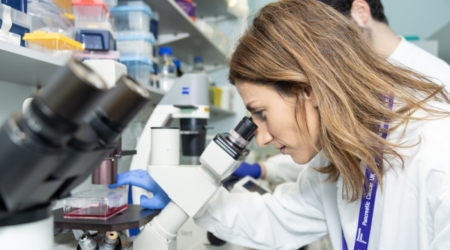
We’ve invested over £7 million so far in cutting-edge research aimed at improving the early detection of pancreatic cancer. Our funding has helped lay the critical groundwork for the development of tests and tools to identify people with pancreatic cancer faster.
And we’ve been working hard to make sure that, as soon as those tests are available, they are implemented in the clinic at the earliest possible stage.
“A few years ago, we knew a little bit about early detection of pancreatic cancer, but finally people are realising how important it is. The future is really exciting”
Identifying and monitoring those most at risk
We don’t fully understand exactly what causes pancreatic cancer yet, but certain risk factors – like family history, pancreatic cysts, chronic pancreatitis, or a recent diabetes diagnosis – can all increase the likelihood of developing it.
We’ve funded research to understand how to identify and monitor people at risk of developing pancreatic cancer so that they can be identified and treated earlier, even before symptoms develop.
We’ve improved access to regular monitoring for people with a family history of pancreatic cancer
Most cases of pancreatic cancer do not run in families. However, around 1 in 10 are thought to be inherited. We have funded the EUROPAC study, led by Professor Bill Greenhalf at the University of Liverpool, which is investigating the genetic basis of both pancreatic cancer and pancreatitis. Through this study, people with a family history of pancreatic cancer may be able to receive regular monitoring that aims to identify any changes to their pancreas at an early stage when treatment is more likely to be successful.
In 2024 we launched an online Family History Checker to help people with more than one family member affected by pancreatic cancer find out if they could benefit from this regular monitoring. In its first year, over 71,000 people used the Family History Checker to check their family risk, resulting in over 3,000 people being referred to the EUROPAC study.
We’re developing a test to identify people with type 3c diabetes
People with new-onset diabetes are one of the largest at-risk groups for pancreatic cancer. There is a specific subtype of diabetes called type 3c diabetes, which increases your risk of pancreatic cancer. However, there is currently no way for doctors to distinguish this from the more common type 2 diabetes. Our support has enabled Professor Eithne Costello’s team at the University of Liverpool to identify biological markers in the blood that could be used to identify type 3c diabetes.
We’re now funding Dr Lucy Oldfield to take this work to the next stage and develop a blood test that could be used by GPs to quickly identify type 3c diabetes in patients with a new diagnosis of diabetes so that they can be quickly referred for further tests to check if they have pancreatic cancer.
We’ve developed a new tool to predict risk of pancreatic cancer
We funded Dr Pui San Tan and Professor Julia Hippisley-Cox at the University of Oxford to develop a new computer-based tool that can predict the risk of pancreatic cancer in patients with new onset diabetes more accurately than current guidance. Once it has been tested further, this clinical tool has the potential to be easily applied alongside other online tools already being used to help GPs identify those most at risk of developing pancreatic cancer so that they can be referred for further investigation sooner.
We’ve worked with NHS England to launch a new pilot to identify those most at risk
We’ve supported NHS England in developing a new initiative that uses the risk tool developed by our researchers, alongside others, to identify people recently diagnosed with diabetes who also have other symptoms or risk factors of pancreatic cancer. This pilot will routinely search GP records to proactively identify people over 60 with a recent diabetes diagnosis who have experienced unexplained weight loss, and test whether this approach improves early detection of pancreatic cancer.
“We’re proud to have been involved in shaping this new case finding pilot, which will support GPs to proactively find people with pancreatic cancer among one of largest groups known to be at increased risk. If this pilot is successful, we will be calling for this initiative to be expanded across the country to help give more people affected by the deadliest common cancer the very best chance of survival.”
Generating tests and tools to identify people with symptoms at the earliest possible stage
Over 90% of pancreatic cancer patients visit their GP with relevant symptoms in the two years before diagnosis, representing a crucial window of opportunity for earlier detection. We urgently need tools to help GPs identify patients presenting with vague symptoms who are most likely to have pancreatic cancer so that they can be quickly referred for further investigations.
We’re developing new tests for pancreatic cancer
Thanks to research we have funded, several promising tests are now in development that could improve early detection of pancreatic cancer. We set up the Early Diagnosis Research Alliance which brought together a world leading team of experts, led by Professor Steve Pereira at University College London, with the aim of making significant progress towards earlier detection of pancreatic cancer.
The team showed for the first time that it is possible to use molecules found in the blood to create an accurate test for pancreatic cancer. Their research also demonstrated that the GP surgery would be the best place for a pancreatic cancer blood test to be performed, a finding which is helping guide the development of new tests.
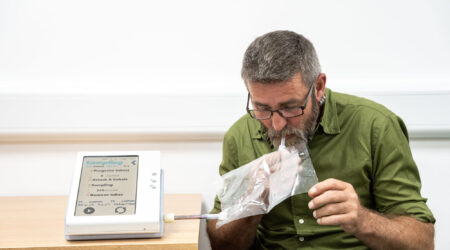
We also funded Dr Piers Boshier at Imperial College London to investigate the molecular basis of chemicals released in the breath, Volatile Organic Compounds (VOCs) as a potential avenue for pancreatic cancer detection. This project found specific VOCs relating to pancreatic cancer.
These results fed into another exciting project we fund, led by Professor George Hanna, to develop the world’s first breath test for pancreatic cancer by detecting VOCs. This could be a game changer for the early detection of pancreatic cancer.
“The data [on the breath test] so far is promising and this is really exciting. We feel that this test can make a difference and detect pancreatic cancer earlier, which has the potential to save many lives”
We’re laying the groundwork to ensure rapid adoption of new early detection tests
With several early detection tests for pancreatic cancer currently in development, it is vital that we also work to ensure that GP surgeries are ready to start using them as soon as possible once they become available. We’ve funded Dr Patrick Kierkegaard at Imperial College London to develop a toolkit for GPs to identify barriers that may impact adoption of these tests so that they can be supported to start using them as quickly as possible. This is a critical step in moving new early detection tests into the clinic so that patients can benefit from these advances as soon as they become available.
We’ve shed new light on the symptoms of pancreatic cancer
Identifying people with pancreatic cancer is challenging due to vague symptoms. The EDRA team identified two new symptoms associated with pancreatic cancer; thirst and dark urine. This was used to improve QCancer, a computer- based tool used by GPs to aid cancer diagnosis, improving the ability of GPs to identify pancreatic cancer.
Your support is helping us to detect earlier
Thanks to your dedicated support, we’ve made vital progress in helping to identify and monitor those at risk of developing pancreatic cancer as well as developing the tests we need to pinpoint people with symptoms at the earliest possible stage.
It is crucial that we continue this momentum to drive forward the breakthroughs in early detection that we so desperately need.