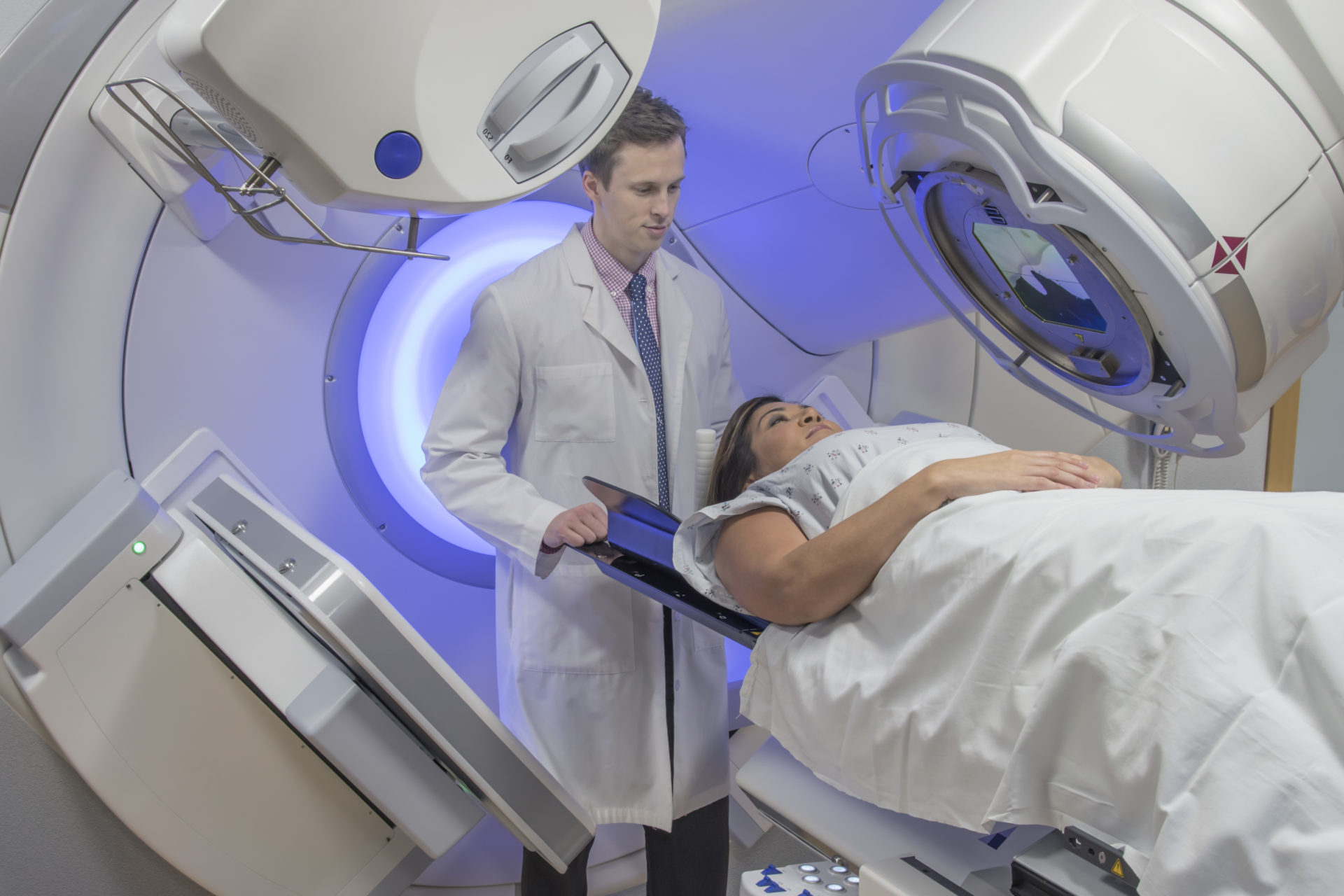
Woman Receiving Radiation Therapy Treatments for Breast Cancer

Radiotherapy for pancreatic cancer

Radiotherapy may be a treatment option for some people with pancreatic cancer. It may be used on its own or together with chemotherapy. The aim is to control the cancer and relieve symptoms.

Key facts

  • Radiotherapy uses radiation to destroy the pancreatic cancer cells. You may have it on its own, or together with chemotherapy (chemoradiotherapy).
  • Different types of radiotherapy are used for pancreatic cancer. These include intensity modulated radiotherapy (IMRT), volumetric modulated arc radiotherapy (VMAT), stereotactic ablative body radiotherapy (SABR) or stereotactic body radiotherapy (SBRT). Your radiotherapy team will decide the best and safest treatment for you.
  • You will usually go to the hospital on weekdays (Monday to Friday) for your radiotherapy. How long treatment lasts will vary, but it is usually about three to six weeks.
  • Radiotherapy can cause side effects but these are often mild. They may include fatigue, feeling and being sick, and runny poo. Your medical team will help you manage them. If you have chemoradiotherapy, you may also get side effects from the chemotherapy.

Who can have radiotherapy?

Radiotherapy is used in different ways depending on your diagnosis and the stage of the cancer. You may have radiotherapy for:

Radiotherapy for borderline resectable pancreatic cancer

Borderline resectable cancer is cancer that has grown very close to the major blood vessels near the pancreas.

You may be offered chemotherapy on its own first. Chemotherapy together with radiotherapy (chemoradiotherapy) may then be suitable for some people with borderline resectable pancreatic cancer. These treatments aim to shrink the cancer enough to make it possible to remove it with surgery. You will usually have a CT scan four to six weeks after chemoradiotherapy, to check whether surgery might be possible.

Radiotherapy for locally advanced pancreatic cancer

Locally advanced pancreatic cancer is cancer that has spread to the large blood vessels near the pancreas, or to several lymph nodes.

You may be offered chemotherapy, and then radiotherapy together with chemotherapy (chemoradiotherapy). Stereotactic ablative body radiotherapy (SABR) may also be an option for locally advanced cancer, usually after at least three months of chemotherapy.

Chemoradiotherapy or SABR may help control the cancer and slow down its growth. For a very small number of people with locally advanced cancer, they may shrink the cancer enough for it to be removed with surgery. A CT scan is usually done 12 weeks after chemoradiotherapy to see how well it has worked.

Radiotherapy for advanced pancreatic cancer

If you have cancer that has spread to other parts of the body (advanced or metastatic cancer) it may cause pain by pressing on other organs or nerves near the pancreas. You may be able to have radiotherapy to help relieve the pain. This is called palliative radiotherapy.

Palliative radiotherapy may also be helpful if the cancer has spread to other places such as the bones.

Sometimes the cancer can spread to the bones in the spine or tissues around the spinal cord and can press on the spinal cord. This is called metastatic spinal cord compression (MSCC). It is rare but it can be serious. Radiotherapy is the most common treatment for MSCC.

Read more about treatments to manage pain.

Read our fact sheet about radiotherapy

To read about radiotherapy, download our fact sheet.

Download our fact sheet

Questions to ask your doctor or nurse


  • Why is radiotherapy recommended for me?
  • Will radiotherapy help control my cancer or help me to live longer?
  • Will radiotherapy help any of my symptoms?
  • How long will I have radiotherapy for?
  • How long will each session last?
  • Will I have chemotherapy as well as radiotherapy?
  • What side effects might I get?
  • How can the side effects be managed?
  • Who do I contact if I have side effects?
  • Will I have any long term side effects?
  • Which hospital will I go to for radiotherapy?
  • Are there any clinical trials using radiotherapy or chemoradiotherapy that I could take part in?
  • How soon will I know if the treatment is working?
  • Are there any other treatment options that would be suitable for me?

Speak to our specialist nurses

Speak to your doctor or nurse about whether radiotherapy is an option for you. You can also contact our specialist nurses on our free Support Line with any questions or worries about radiotherapy.

Contact our nurses
Lynne Specialist nurse at Pancreatic Cancer UK

References and acknowledgements


Acknowledgements

We would like to thank the following people who reviewed our information on radiotherapy

  • Catriona Buchan, Radiotherapy Advanced Practitioner, Leeds Teaching Hospitals NHS Trust
  • Mairead Daly, Therapeutic Radiographer and Postdoctoral Research Associate, The University of Manchester
  • Ganesh Radhakrishna, Consultant Clinical Oncologist, The Christie NHS Foundation Trust, Manchester
  • Pancreatic Cancer UK specialist nurses

References

We have listed some of the references to the sources used to write this information. If you would like the full list of references, email us at publications@pancreaticcancer.org.uk

  • Pan L, Fang J, Tong C, Chen M, Zhang B, Juengpanich S, et al. Survival benefits of neoadjuvant chemo(radio)therapy versus surgery first in patients with resectable or borderline resectable pancreatic cancer: a systematic review and meta-analysis. World Journal of Surgical Oncology 2020;18:1. doi.org/10.1186/s12957-019-1767-5.
  • Janssen QP, van Dam JL, van Bekkum ML et al. Neoadjuvant FOLFIRINOX versus neoadjuvant gemcitabine-based chemoradiotherapy in resectable and borderline resectable pancreatic cancer (PREOPANC-2): a multicentre, open-label, phase 3 randomised trial. Lancet Oncology. 2025;26(10):P1345-1356.
  • Tchelebi L, Lehrer E, Trifiletti D, Sharma N, Gusani N, Crane C, Zaorsky N. Conventionally Fractionated Radiation Therapy Versus Stereotactic Body Radiation Therapy for Locally Advanced Pancreatic Cancer (CRiSP): An International Systematic Review and Meta-Analysis. Cancer 2020;126:2120-2131.
  • Hu Q, Wang D, Chen Y, Li X, Cao P, Cao D, et al. Network meta-analysis comparing neoadjuvant chemoradiation, neoadjuvant chemotherapy and upfront surgery in patients with resectable, borderline resectable, and locally advanced pancreatic ductal adenocarcinoma. Radiation Oncology 2019;14:120. doi.org/10.1186/s13014-019-1330-0.
  • Tello Valverde C, Ebrahimi G, Sprangers MA, Pateras K, Bruynzeel A, Jacobs M, et al. Impact of Short-Course Palliative Radiation Therapy on Pancreatic Cancer-Related Pain: Prospective Phase2 Nonrandomized PAINPANC Trial. International Journal of Radiation Oncology, Biology, Physics 2024;118(2):352-361. doi: 10.1016/j.ijrobp.2023.08.055.

Updated January 2026

To be reviewed January 2029