


Rare Cancers Bill passes Second Reading in the House of Lords
An update on the Rare Cancers Bill as it progresses through Parliament.
Earlier this month – fittingly, during Less Survivable Cancers Week – our team were delighted to be in the House of Lords to watch the Rare Cancers Bill successfully pass its Second Reading.
After just over two hours of passionate, rousing and at times emotional speeches, the Bill was unanimously supported by peers from across political parties. Now, just one more hurdle – Third Reading – remains before it completes its journey, and starts to transform pancreatic cancer research as the historic Rare Cancers Act.
We’re delighted that the Bill has come this far and will be doing everything we can to get it over the finish line. Only 4% of Private Member’s Bills typically become law – so this would be an incredible achievement!
We now eagerly await Third Reading, which is set to take place in late February.

What is the Rare Cancers Bill?
The Rare Cancers Bill is a Private Members Bill introduced by Dr Scott Arthur, the MP for Edinburgh South West. The Bill has the potential to drive much-needed research and ensure a greater focus on cancers affecting fewer than 1 in 2,000 people across the UK.
We have been proud to support Dr Scott Arthur MP throughout the passage of the Bill in Parliament so far, working alongside our charity partners, The Brain Tumour Charity and Brain Tumour Research, more than 30 other charity and industry organisations backing the Bill, and supported by pro-bono work from public affairs consultancy, H/Advisors Cicero.
From drop-in events to 1-2-1 meetings and supporter outreach, we have been doing everything we can to reach as many parliamentarians as possible. By highlighting what this Bill would mean for people with pancreatic cancer and other less survivable cancers, we’ve demonstrated why it’s so important this Bill gets their support.
Watch the video here to hear a few highlights from the Third Reading Debate in the house of Commons.
What happens next?
- The Bill will now be examined by a committee of the whole House of Lords, where peers examine it line-by-line.
- This will be followed by Third Reading. This is a much more straightforward affair, and should only take around 15 minutes of discussion before being passed. This is likely to take place in late February.
- Following this, the Bill will go to the King for Royal Assent, at which point it officially becomes law. We hope this will happen sometime during March.
- We will continue to work closely with Peers and MPs to ensure the Bill completes these final few steps as quickly and as smoothly as possible.
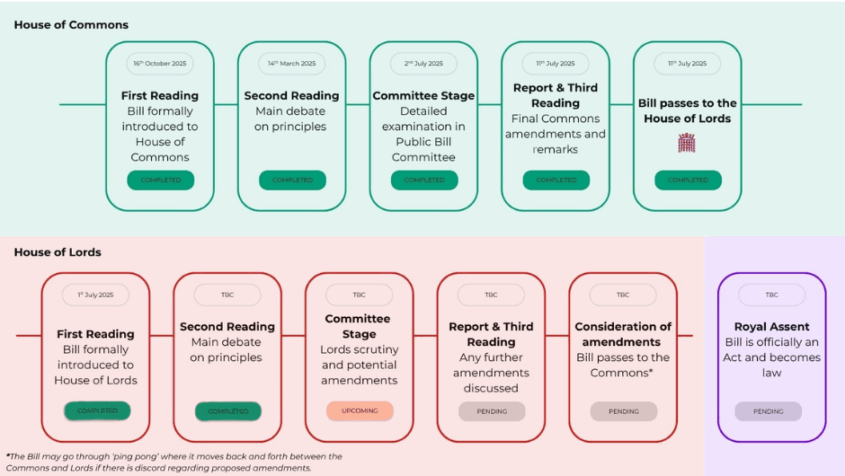
To see a larger version of this, see here.
How will the Bill help those with pancreatic cancer?
This Bill could deliver major breakthroughs for people with pancreatic cancer and improve survival rates. Pancreatic cancer is one of the deadliest cancers with a 5-year survival rate of just 7%. Sadly, survival rates have remained largely the same over the last 25 years – in part due to a lack of research and research investment. This Bill offers an opportunity for real change. If this Bill becomes law, it will help to deliver the much-needed research investment and attention it deserves.
What would the new law do?
The Rare Cancers Bill has the potential to transform survival for these cancers by encouraging a greater focus and drive in research on these areas. The law would:
- Ensure there’s a named lead in government with a responsibility to support research and innovation for these cancers.
- Ensure patients can get better access to and find out about relevant research and clinical trials.
- Place a duty on the Government to review (and potentially strengthen) “Orphan Drug Regulations”.


Other news
-

10 September 2026
Responding to the Welsh Government’s call for evidence for the Welsh Cancer Strategy
The Welsh Government are developing a National Cancer Strategy, and they want to hear from you on what should be included.
Read more -
10 September 2026
Signs of progress for pancreatic cancer care
We share some key findings and recommendations from the National Pancreatic Cancer Audit published on 10th September 2026.
Read more -
27 August 2026
Advanced clinical trial for world-first pancreatic cancer breath test begins recruiting in Wales
A world-first breath test for pancreatic cancer is now being trialled on patients outside of England for the first time, at Wrexham Maelor Hospital.
Read more


-
10 September 2026
Responding to the Welsh Government’s call for evidence for the Welsh Cancer Strategy
The Welsh Government are developing a National Cancer Strategy, and they want to hear from you on what should be included.
Read more -
10 September 2026
Signs of progress for pancreatic cancer care
We share some key findings and recommendations from the National Pancreatic Cancer Audit published on 10th September 2026.
Read more -
27 August 2026
Advanced clinical trial for world-first pancreatic cancer breath test begins recruiting in Wales
A world-first breath test for pancreatic cancer is now being trialled on patients outside of England for the first time, at Wrexham Maelor Hospital.
Read more