
Everyone has a pancreas (unless it has been removed).
What does the pancreas do?
Your pancreas does two main things.
- It makes enzymes that help to break down food so your body can absorb the nutrients from it. This is part of digestion.
- It makes hormones, including insulin, which control the sugar levels in your blood.
Where is the pancreas in the body?
The pancreas sits behind your stomach, at the back of your tummy (abdomen).
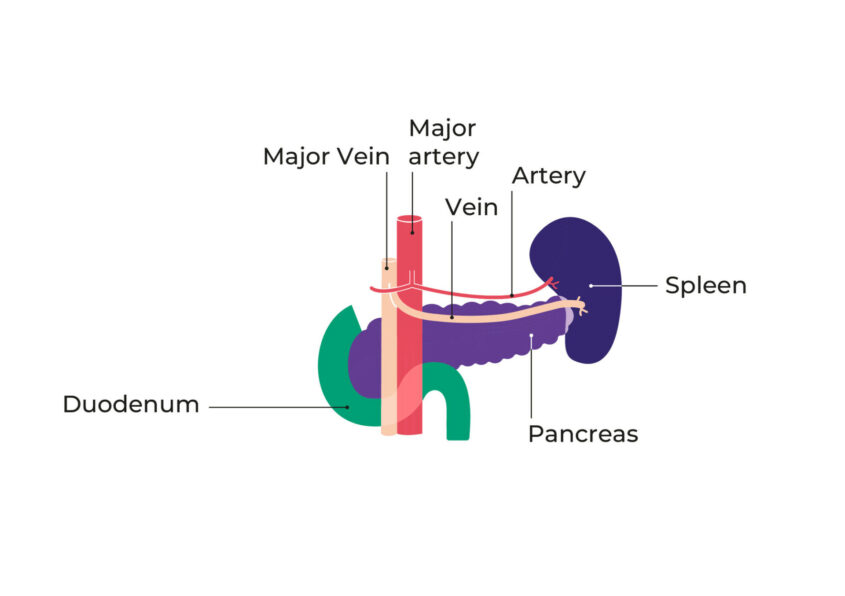
The pancreas is often described as having a head, body and tail. It is surrounded by several important organs, such as the liver, and also by large blood vessels and lymph nodes (part of your immune system).
Diagram showing the pancreas and surrounding organs
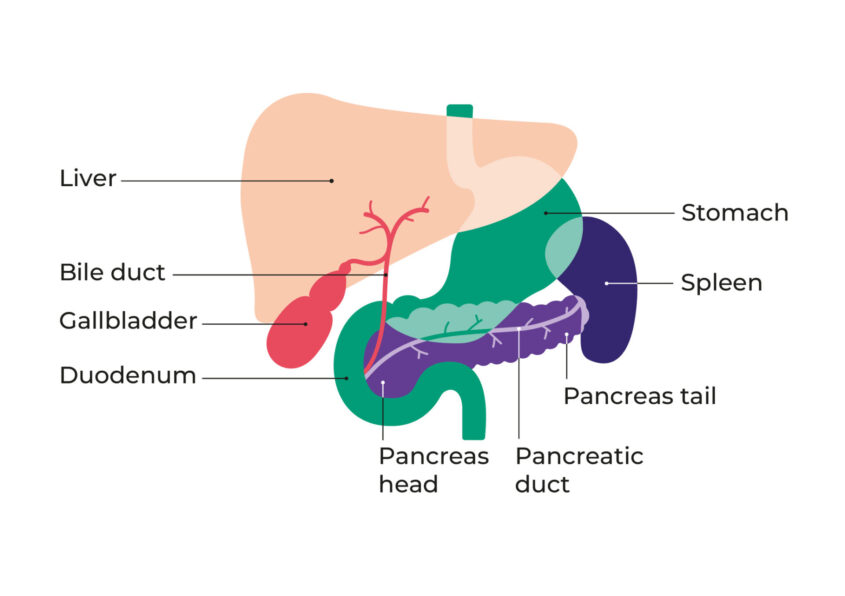
Diagram showing the pancreas and surrounding blood vessels
How does cancer affect the pancreas?
Pancreatic cancer develops when cells in the pancreas grow out of control. Pancreatic cancer can affect how well your pancreas works. You may have problems digesting your food and controlling sugar levels in your blood (diabetes).
Can problems with the pancreas cause symptoms?
Pancreatic cancer often doesn’t cause symptoms in the early stages. As the cancer grows, it may start to cause symptoms. Symptoms include indigestion, tummy or back pain, changes to your poo, weight loss and jaundice. Read more about the symptoms.
If you’re worried about signs and symptoms, talk to your GP.
References
We have listed some of the references to the sources used to write this information. If you would like the full list of references, email us at publications@pancreaticcancer.org.uk
- Liao W et al. Identifying symptoms associated with diagnosis of pancreatic exocrine and neuroendocrine neoplasms: a nested case-control study of the UK primary care population. Br J Gen Pract 2021; doi: https://doi.org/10.3399/BJGP.2021.0153.
- Chapman D et al. First results from five multidisciplinary diagnostic centre (MDC) projects for non-specific but concerning symptoms, possibly indicative of cancer. British Journal of Cancer. 2020;123(5):722-9.
- Walter F et al. Symptoms and patient factors associated with diagnostic intervals for pancreatic cancer (SYMPTOM pancreatic study) a prospective cohort study. Lancet Gastroenterology Hepatology. 2016; 1: 298-306. doi: https://doi.org/10.1016/S2468-1253(16)30079-6
- Tseng DS et al. Pancreatic exocrine insufficiency in patients with pancreatic or periampullary cancer: A systematic review. Pancreas. [Online] 2016;45(3):325-330. Available from: doi: 10.1097/MPA.0000000000000473
- Wynne K, Devereaux B, Dornhorst A. Diabetes of the exocrine pancreas. Journal of Gastroenterology and Hepatology. [Online] 2019;34(2):346-354. Available from: doi:10.1111/jgh.14451
Published March 2026
To be reviewed March 2029